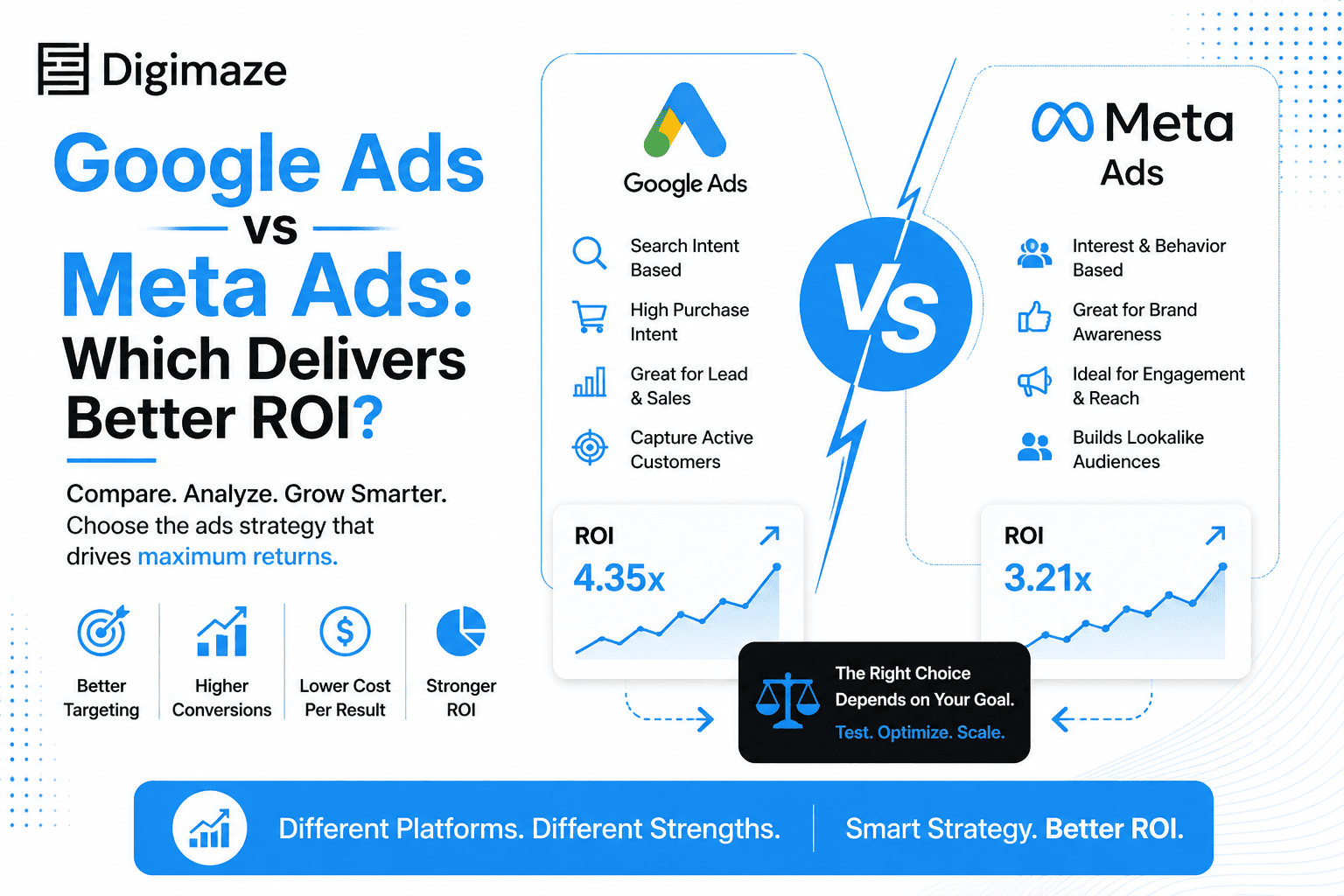
Every business owner running paid campaigns eventually faces the same big question: Google Ads vs Meta Ads, which one is actually worth the money? The digital world today is moving at a breakneck speed, and businesses are constantly assessing where to invest their ad budget for maximum returns. The debate around Google Ads vs Meta Ads is one of the most common in performance marketing. Whether you’re a growing brand or an established business, understanding the difference between Google Ads and Facebook Ads can directly impact your ROI.
Both platforms are powerful, but they serve different purposes. So instead of asking which is better Google Ads or Facebook Ads, the real question should be which one works better for your brand’s specific goals?
Your brand’s goals would decide how you should distribute your budget, either by search intent through Google Ads, or tap into the massive social audiences of Facebook Meta Ads and Instagram Ads.
In this blog, we will break down the real difference between Google Ads and Facebook Ads, compare costs, targeting strategies, and show you exactly which is better for your specific goals.
What Are Google Ads?
Google offers a paid advertising platform called Google Ads. It enables companies and brands to display advertisements when a search is made. Intent-based advertising is the fundamental concept of Google Ads. A user is already searching for something or in need of something when they utilize the Google search engine. At that point, the advertisement appears, and the likelihood of a convert is very high.
Google Search, YouTube, Gmail, Google Display Network, and millions of partner websites are among the ad forms displayed. In essence, you are purchasing visibility at the precise moment a prospective client is searching for a solution when you run Google Ads. For instance, the advertisement shows up first when someone searches for "best running shoes under 3000 rupees" using keywords.
If you're exploring How To Run Google Ads, the process revolves around selecting relevant keywords, creating ads aligned with those searches, setting budgets, and continuously optimizing performance. The strength of this platform lies in reaching users who are actively looking for solutions, making it one of the most reliable tools for driving immediate results.
What Are Meta Ads?
Meta Ads refer to paid Facebook, Instagram, WhatsApp and Messenger ads through Meta’s Ad Manager. Unlike Google, Meta works on interest-based advertising. So, instead of targeting what people are searching for, Meta targets people based on demographics, interests, behaviours and life events.
Instagram Ads are a part of Meta's ecosystem and are quite powerful for brands that need visual power, like food, fashion, lifestyle, and e-commerce. 70% of audiences refer to social media for information about brands and through Social Media ads. It shows you ads before you even know you need their product, and it works perfectly for brand building and brand awareness. Meta believes in a completely different principle; instead of capturing demand, they focus on creating it.
The key formats for Meta ads are Static, Video, Carousel, Stories, Reels, Collection, and Lead generation forms. Users going through Facebook or Instagram are not necessarily looking to buy something. On these platforms, users come to consume content, connect with others and explore different accounts.
This makes Meta Ads incredibly effective for discovery. A well-designed campaign can introduce your brand to people who didn’t even know they needed your product. While Meta Search Ads are emerging, the platform’s real strength continues to lie in visually engaging formats and precise audience targeting.
The Core Difference Between Google Ads and Facebook Ads
The difference between Google Ads and Facebook Ads is understanding their algorithm and ecosystems. The biggest difference is user intent. Google Ads responds to what users are searching for, and Meta Ads responds to what users might be interested in based on their behaviour patterns.
Both the platforms work differently in everything from ad formats to performance outcomes. Google Ads tends to be more direct and conversion-focused, while Meta Ads are more consumption and storytelling-driven.
Google captures existing demand, while Meta, on the other hand, builds new demand.
Particulars | Google Ads | Meta Ads |
Ad Intent | Search based | Interest based |
Targeting | Keywords, location, device | Demographics, interests, behaviour |
Ad Formats | Text, Shopping, Display, Video | Image, Video, Carousel, Reels, Stories |
Best For | Purchase-ready customers | Brand discovery & awareness |
Audience Size | Search-limited | 3.27B+ social users |
Visual Appeal | Mostly text-based search ads | Highly visual and creative |
Funnel Stage | Bottom of funnel (BOF) | Top & Middle of funnel (TOF & MOF) |
Google Ads vs Facebook Ads Cost: What to Expect
One of the most searched questions by businesses is the cost of Google Ads vs Facebook Ads.
Google Ads cost per click (CPC) tends to lean on the high side because you bid on keywords that have stronger purchase intent. There are many industries like finance, legal and real estate, which are quite competitive and these clicks can lead to a higher cost per click due to multiple people bidding on it. Typically, it ranges from ₹10 to ₹300+ per click depending on the industry.
The CPC can be higher but they are search-based, so the intent to convert is also high because the user is already in a decision-making process.
Now we discuss Meta Ads and its Cost Per Thousand Impression (CPM), which usually offer lower costs in terms of impressions and clicks. On Meta, you can reach thousands of people with a very modest daily budget but you require attractive visuals and creativity. Meta is a place audience consumes a lot of content so the window is barely 3 seconds and conversion results aren’t much higher. Users aren’t generally searching for the product so Meta mostly is for acquiring new audiences and spreading brand awareness.
Now that we know the costing, it's easier to understand where to spend the budget and how to distribute it effectively. Google Ads may seem more expensive but it has a higher chance of conversion and brings quality traffic that often balances out the CPC. Meanwhile, Meta Ads has cost efficiency but lower conversion. It requires multiple touchpoints for better conversion. For the best ROI, many businesses combine both.
Google Ads vs Instagram Ads: A Creative Divide
The difference is much more noticeable when comparing Instagram and Google ads. The classic difference between them is their format. Google Ads is all about logic and need, whereas Instagram Ads are all about visuals and emotion.
Google Search Ads are text-heavy and work on the keyword module; however, Instagram Ads mostly prefer storytelling and engagement through Reels, Stories, Carousels and Static Posts.
On Google, your search determines the ads but on Instagram, aesthetics matter. Brands rely on design and visual appeal to attract consumers, especially in sectors like lifestyle, travel, and FMCG. Instagram Ads can generate noise and fantastic engagement at a relatively low cost.
If you plan on selling software or services or sectors like BFSI and tech, then Google Ads works great for you, as it's something people would search for and that would likely drive results for you.
Google Ads vs Social Media Ads: The Bigger Picture
If we compare Google Ads vs Social Media Ads, then we need to think beyond Facebook, because social media entails much more than just Facebook, WhatsApp and Instagram. Social Media consists of platforms like LinkedIn, Twitter now X, Pinterest, Discord and Snapchat. However, Meta apps dominate the market in terms of ROI and audience size.
On the other hand, Google is the largest advertising ecosystem in the world, covering search, YouTube, Gmail, and the Display Network. When it comes to both reach and intent-targeting, Google Ads is superior to social media ads. However, social media platforms are superior in terms of top-of-funnel brand building, audience engagement, and creativity.
The more comprehensive comparison of social media ads and Google Ads explains how both platforms fit into various phases of the customer journey.
Google Ads is highly effective at the bottom of the funnel, where users are ready to take action. Social Media Ads, including Meta platforms, are more influential at the top and middle of the funnel, where awareness and consideration are built.
This is why businesses that rely only on one platform often miss out on opportunities. While Google Ads can bring in quick conversions, Social Media Ads help shape perception, build familiarity, and create long-term brand value.
How to Run Google Ads: A Quick Overview
Now that we know the difference between Google Ads and Meta Ads, are you wondering how to run Google Ads? Here's a simplified roadmap for beginners:
Step 01: Set up your Google Ads account
Go to ads.google.com, sign in with your Google account, and create your first campaign.
Step 02: Choose your campaign goal
Select from Sales, Leads, Website Traffic, Brand Awareness, or App promotion.
Step 03: Do keyword research
Use Google Keyword Planner to find high-intent, relevant keywords. Mix broad, phrase, and exact match types.
Step 04: Write attention-grabbing ad copy
Create attention-grabbing headlines (up to 15 characters), strong descriptions (up to 90 characters), and clear CTAs. Use responsive search ads.
Step 05: Set your budget & bidding
Start with a daily budget you're comfortable with. Use Smart Bidding strategies like Target CPA or Maximize Conversions.
Step 06: Track, test & optimize
Connect Google Analytics, set up conversion tracking, and continuously A/B test your ads for better ROI.
How to Run Meta Ads: A Clear Rundown
The next step is learning how to actually run campaigns on Meta platforms. If you're planning to invest in Facebook Meta Ads, Instagram Ads, or other Social Media Ads, here’s a simplified roadmap to get started:
Step 01: Set up your Meta Ads account
Go to Meta Business Suite (business.facebook.com), create your Business Manager account, and set up your ad account. Connect your Facebook Page and Instagram profile to run seamless campaigns across both platforms.
Step 02: Choose your campaign objective
Meta Ads are objective-driven. Select what aligns with your goal: Awareness, Traffic, Engagement, Leads, App Promotion, or Sales. Your choice here directly impacts how the algorithm optimizes your ads.
Step 03: Define your target audience
This is where Meta Ads stand out. You can target users based on demographics, interests, behaviours, and even custom audiences like website visitors. You can also create lookalike audiences to reach people similar to your existing customers
Step 04: Choose your ad placements
Decide where your ads will appear. Facebook Feed, Instagram Feed, Stories, Reels, or Audience Network. For beginners, automatic placements work well, allowing Meta to optimize delivery across platforms.
Step 05: Create scroll-stopping creatives
Unlike Google Ads, Meta is highly visual. Use high-quality images or videos, write engaging primary text, add a compelling headline, and include a strong CTA. Your creative is what makes users stop scrolling.
Step 06: Set your budget & bidding
Choose between a daily or lifetime budget based on your campaign duration. Meta automatically optimizes delivery, but you can control spending limits and bidding strategies depending on your objective.
Step 07: Track, test & optimize
Install the Meta Pixel on your website to track user behaviour and conversions. You can monitor performance regularly, test different creatives and audiences, and refine your campaigns to improve ROI over time.
Which Is Better — Google Ads or Facebook Ads?
What works best between Google Ads and Facebook Ads depends on the nature of your business. There is no definitive answer to this question.
If your goal is to create leads or make sales straight away, Google Ads often yields faster results. It connects you with those who are already looking for what you have to offer.
If your goal is to build a brand, draw in new customers, or create demand, meta ads work better. They enable you to tell your story, showcase your products, and stay at the top of people's minds.
The best digital marketers use Google Ads to capture existing demand and Meta Ads to create new demand, rather than picking one over the other. Together, they address every step of the consumer journey, from awareness to conversion.
The ROI Verdict
Although they do so in different ways, both platforms are capable of generating outstanding ROI results.
Google Ads usually have a higher conversion rate because they target users with a specified goal. This makes it ideal for businesses looking for rapid revenues.
On the other hand, over time, meta advertising often result in higher ROI. They create a connection with the audience, pique curiosity, and increase awareness. This long-term effect may have a significant influence on future purchasing decisions.
For example, a customer might locate a product through Instagram Ads, engage with the company over time, and then research it on Google before making a purchase. Thus, both have a part in the ultimate conversion.
The Smart Approach: Using Both Platforms
Rather than debating Google Ads vs Meta Ads, high-performing brands focus on how the two can work together.
Meta Ads can be used to introduce your brand and create interest amongst potential customers. Once that interest is established, Google Ads can capture users when they actively search for your product or service.
This combined strategy ensures that you’re not only reaching new audiences but also converting them when they’re ready to take action. It creates a continuous journey from discovery to decision.
Conclusion
There is no definitive winner for Google Ads vs Meta Ads or Facebook Ads. The conversation around these two is often to identify which can outperform the other. However, it can never happen. Both the platforms are powerful in delivery strong ROI only if understood well. The key to both the platform is their audience, their budget and the customer buying journey.
One is built to capture demand while the other is designed to create demand.
If you’re evaluating Google Ads vs Facebook Ads cost, considering Google Ads vs Instagram Ads, or exploring Google Ads vs Social Media ads, the answer will always depend on your objectives. So instead of choosing sides, focus on strategy.
Because the brands that see the best ROI aren’t asking which is better, Google Ads or Facebook Ads. They’re leveraging both to their full potential.

MUMBAI

PUNE