You’ve tried and tested every formula that exists to bring visitors to your website. You’ve run performance ads, tried to invest in SEO, and even stayed consistent in posting on social media. But here’s the reality: the consequences most businesses face are visitors who take no action. All these efforts lead to no results.
Getting traffic on site is only a small part of the challenge, but the most important thing to consider is whether these visitors are taking any action or not. Conversions are the main target when you’re running an e-commerce store, SaaS platform, or a service-based company. However, many companies have low conversion rates despite spending a lot of money on performance marketing and SEO.
This is where conversion rate optimization (CRO) can help. Instead of trying to attract more traffic, focus on making better use of the traffic you already have. Smart CRO methods allow you to convert more visitors into sales without increasing your ad expense.
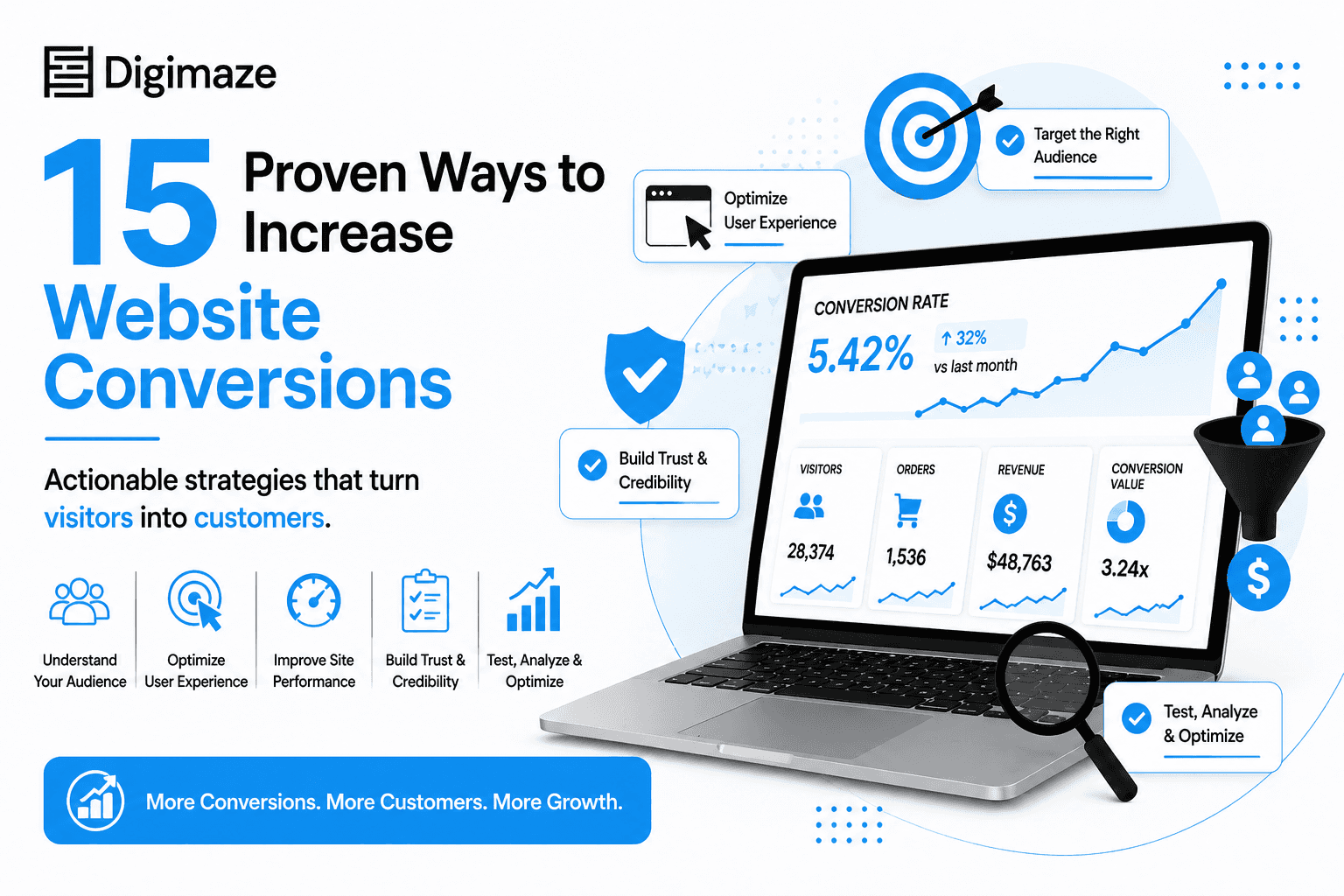
In this guide, Digimaze Marketing walks you through 15 proven ways to increase website conversions, along with practical website conversion tips explained in a way that’s easy to understand and apply.
What is Conversion Rate Optimization?
Conversion Rate Optimization is a process that helps improve your website so that more visitors take action on your website. That action can be anything depending on the nature of the business or website, like filling out a query form, making a purchase, booking a consultation, or even signing up for a newsletter.
In simple terms, the number of visitors who complete the desired action on the website, that particular percentage is known as the conversion rate. For eg, if 200 out of 10,000 visitors make a purchase, your conversion rate is 2%.
The core of Conversion Rate Optimization is understanding why the remaining visitors do not convert and then make effective solutions to overcome those barriers. You don’t need more traffic to see conversion results; all you need is to make smarter improvements to your existing website and see how everything changes for the better.
15 CRO strategies to improve your Website Conversion Rate
The following CRO approaches are all tried-and-tested. These small changes can improve your website's performance and conversion rate, regardless of whether you operate a service company, an e-commerce store, or a SaaS platform.
1. Speed up your website
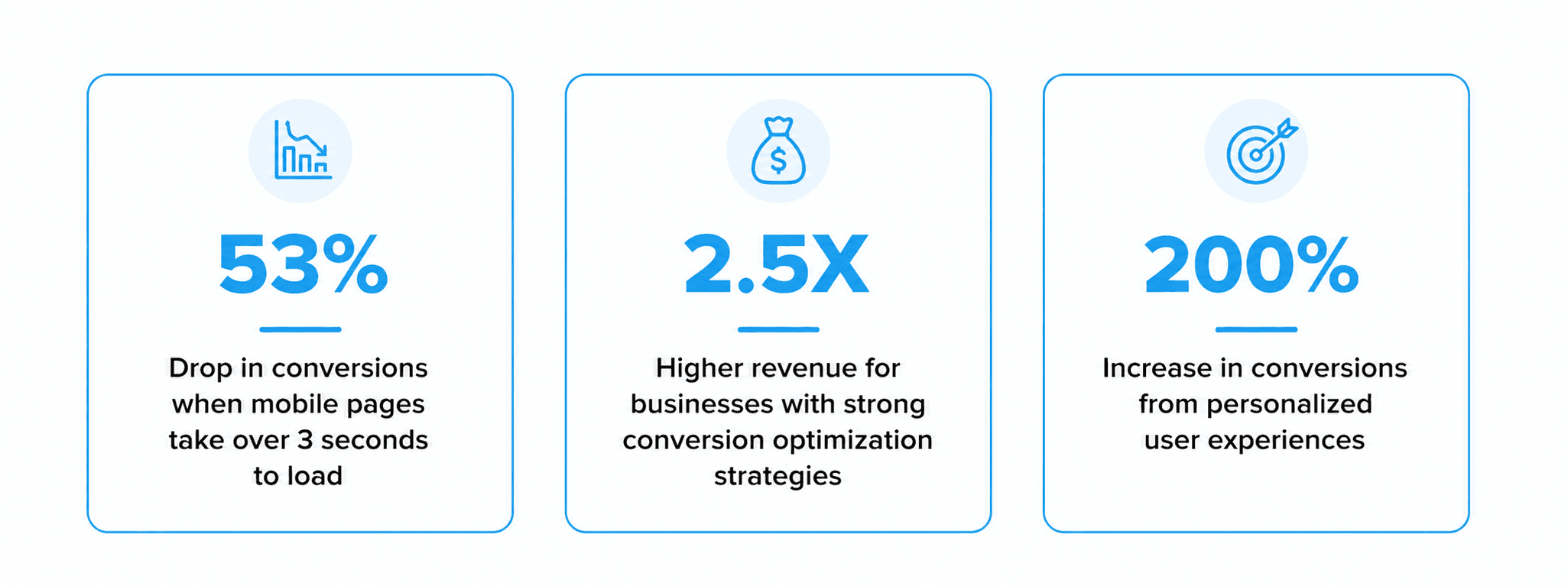
This is one of the quickest ways to increase website conversions. A slow website drives visitors away before they even see your offer. Research shows that even a one-second delay in page load time can impact conversions big time. People expect speed, and if they do not get it, they leave.
Check your website with simple tools like Google PageSpeed Insights or GTmetrix to see why it is slow. If pictures are too big, reduce the resolution and make them smaller. When your website is fast, people do not get tired of waiting. They stay, click, and are more likely to buy or sign up. If needed, use better hosting so your site runs faster.
A fast website just does not improve your user experience but also helps in improving website conversion rate results. Here’s a tip: Your website page should load under 2 seconds. This keeps the users engaged and shows measurable growth in conversions.
2. Write clear and action-driven CTAs
Clear action-driven CTAs have a high impact on conversions. Your call to action is where users make decisions and if it's unclear or generic, users tend to hesitate. So instead of using vague phrases like ‘Submit’ or ‘Click here’ as CTAs that tell the visitor nothing, focus on giving clarity and showing up with intent.
For eg, ‘Get your free quote’ or ‘Start your 7-day trial’ grabs more attention and works much better. It tells the user exactly what needs to be done and what they will get.
Adding the correct CTA and placing it at the correct place is also important. It plays a key role in making a decision. CTAs should be at places where users can naturally make a decision, such as above the fold on landing pages, after the key sections or at the end of the blog.
Clear CTAs are one of the simplest yet most effective website conversion tips. Phrases like ‘Limited Offer’ or ‘Only 3 Spots Left’ create urgency and urgency led CTAs pressurise the users and motivate them to take action.
3. Add social proof to your website
In today’s digital era, trust plays a huge role in conversions. People tend to trust other customers more than brand messaging. Social proof is one of the most powerful tools in the CRO arsenal and it works in several ways. In simple terms, visitors want reassurance before taking action.
Social proof works as a trust builder, like customer reviews, testimonials, case studies and logos of the brand you’ve worked with for more credibility. Simple elements like user counts or purchase notifications on an e-commerce website can influence purchasing decisions. For eg, notifications like ‘Jinal from Surat just purchased heels’ and user counts like ‘Join 10,000+ happy customers.’ In addition to that, you can add trust badges like SSL certificates, money-back guarantee, or industry certifications near the CTA buttons to reduce customer doubts.
When you add these to your landing pages, product pages, checkout flows and even homepage or service page can subtly but effectively increase website conversions by increasing trust.
4. Set up and analyse your conversion funnel
Understanding user behaviour and its patterns is important because you can’t improve something you can never measure. So, from the first interaction on your website to the final action, conversion funnel optimization focuses on mapping the user journey. This includes steps like landing page visits, product views, add to cart, and checkout completions.
There are multiple tools that can help you show where users drop off, like Google Analytics 4 or Zoho PageSense. They map out your funnel: from landing page → product page → add to cart → checkout → confirmation. They can fix even one weak stage in the funnel and help increase the website conversion rate performance.
Even a 10% improvement in drop-off at a key funnel step can help increase the overall conversion rate.
5. Optimise landing pages for a single goal
There is always a purpose for every website; each landing page has a clear objective. When you try to achieve everything on one page, like selling a product, collecting emails, promoting a webinar, and sharing a blog, visitors get overwhelmed and confused. When a page tries to do too many things, it usually fails to do any of them well.
Landing page should focus on one clear objective. Whether it is collecting leads or driving purchases, the message should stay consistent throughout. Removing unnecessary links, extra CTAs, and unwanted navigation menus is part of solid CRO basics. A well-structured and informed page naturally leads to better results and helps increase website conversions. The simpler the page, the higher the conversion rate is.
6. Run A/B tests Regularly
One of the most important aspects of conversion rate optimization is A/B testing, also known as split testing. It’s the backbone of conversion rate optimization. A/B testing allows you to compare two versions of a page element and helps you understand which one performs better. It can be anything, a headline, an image, a CTA or even a page layout.
Instead of relying on assumptions, you make decisions based on actual user behaviour. Over time, these small improvements add up and help improve website conversion rate. Tools like VWO, Optimizely, or Google Optimize make A/B testing accessible even for small businesses.
7. Make your site mobile-friendly
Over 50% users access the website through their phones. Mostly meta ads like Instagram and Facebook have mobile users, so if the site isn’t optimised for mobile users, there are high chances of losing a major share of potential conversions.
Mobile optimization is a non-negotiable CRO strategy; it is no longer optional. You should always ensure buttons are large enough to tap properly, make sure text is readable enough without zooming much and forms should be short and easy to fill on a small screen. Your site checkout flows should be streamlined for mobile users; if there are too many steps, users tend to drop off midway.
8. Simplify your forms and website layout
Every extra step in a form or at a checkout page can lead to a potential reason for a visitor to give up. Asking for too much information or creating too many steps at checkouts can discourage users. You should keep forms short and checkout info on a single page only.
You can also use multi-step forms to make the process feel less overwhelming. Simplifying forms is a straightforward way to increase website conversions.
The rule of thumb: only ask for what is necessary at that stage of the journey. For a newsletter signup, a name and email is plenty. For a free trial, maybe just an email. You can always collect more information later. Removing just one unnecessary field can increase conversions by 20–30%.
9. Use exit intent popups thoughtfully
Exit intent popups appear with a strong offer or a message when a user is about to leave your website. When done right, this last method can recover a meaningful percentage of visitors who would otherwise be lost.
The key here is to offer something valuable. This could be a discount, a free guide, or a reminder about the product they viewed. Avoid aggressive, hard-to-close pop-ups that annoy users. The goal is to give them one more reason to stay or take action, not to frustrate them into leaving faster.
10. Personalise the user experience
Personalisation is one of the most powerful yet underused CRO strategies available today. Personalisation makes your website feel more relevant. When visitors feel like your website "gets" them, they're far more likely to convert.
Basic personalisation includes showing different content based on where a visitor is from, what device they're using, or how they arrived at your site. You can tailor content based on user location, behaviour, or source of traffic. Advanced personalisation uses browsing history and behaviour to recommend products, tailor messaging, and adjust page content in real time.
Even small personalisation efforts can help increase website conversion rate performance by making users feel understood.
11. Add live chat or chatbot support
Sometimes, visitors are just one question away from converting. They 90% ready to convert but they can’t find the answer quickly, so they leave. That gap is filled by live chat, they provide instant answers at the exact same moment when needed.
Companies and organisations do not have team capacity for 24/7 live chat people, so a well-programmed chatbot can handle common questions around the clock automatically. It's one of those website conversion tips that not only improves website conversion rate but also creates a better user experience.
12. Use high-quality visuals and videos
Visuals and videos influence how users perceive your brand. Low-quality product photos, cluttered layouts, and stock images that are quite generic can reduce conversions. Clear images, clean layouts, and product videos help build trust and make your offering easier to understand. Videos, in particular, can simplify complex information and increase engagement.
This is an often-overlooked but important part of conversion rate optimization. Studies consistently show that pages with explainer videos or product demo videos convert at higher rates than those without. Even a short 60-second video can make a big difference.
13. Retarget visitors who did not convert
Whenever a user visits the website for the first time, they are likely to not convert on their first visit. It’s completely normal, which is why retargeting is important to increase funnel conversions. Retargeting allows you to re-engage with those visitors who dropped off in mid, through Meta and Google Ads. Ads can be seen as they browse other websites, watch YouTube or scroll through social media. Since they are already familiar with the brand, they are more likely to convert.
A well-structured retargeting campaign on Google or Meta, showing relevant products or offers based on what the visitor viewed, can increase your overall conversion rate. Retargeting campaigns have been shown to lift conversions by as much as 150% compared to regular display ads. This strategy is highly effective in helping increase website conversions without relying only new traffic.
14. Build trust with security signals
One of the biggest problems with online conversion is doubt. Visitors wonder: Is this website safe? Will my payment details be protected? Is this company legitimate? Trust is essential, especially during transactions.
You can reduce this doubt significantly by displaying trust signals prominently. These include SSL certificates, payment logos (Visa, Mastercard, Paytm, UPI), security badges from providers like Norton or McAfee, clear refund and return policies, and easy-to-find contact information. When people feel safe, they're far more willing to put in their credit card details or personal information.
Placing these elements near CTAs or checkout pages can reduce hesitation and help increase conversion rate website performance.
15. Track, analyse, and continuously improve
Conversion rate optimization is not a one-time activity. It is a long-term ongoing process. It consists of testing, learning and improving. It uses analytics tools, heatmaps, and user feedback to understand how visitors interact with your website. Identify patterns, test improvements, and refine your approach regularly.
Businesses that consistently analyse and optimise are the ones that successfully increase website conversions over time. Turn these insights into your next round of A/B tests, page redesigns, or funnel adjustments. This continuous improvement mindset is what separates brands with average results from those that grow consistently month after month.
Schedule a monthly CRO review. Even small, consistent improvements compound into massive gains over time.
Conclusions
If you want to make your website more efficient and turn visitors into customers, then you are at the right place. At Digimaze Marketing, we help brands turn visitors into customers through data-backed CRO strategies tailored to your business. Let's audit your website and build a conversion roadmap together.
From applying CRO basics to using strong social proof examples and sharpening your conversion funnel optimization, every improvement contributes to better performance.
Ready to increase your website conversions?

MUMBAI

PUNE